
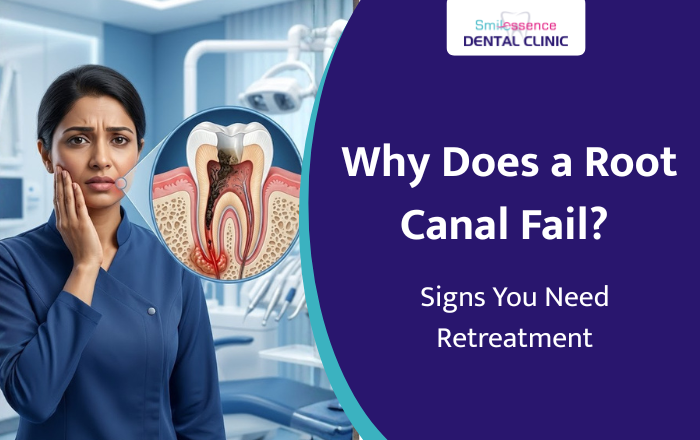
A root canal is meant to save a tooth for good. Most of the time, it does exactly that. But every now and then, a treated tooth starts acting up again weeks, months, or even years later. If that’s happening to you, you’re probably wondering: can a root canal actually fail? And if so, what happens next?
Let’s walk through it in plain language.
Can a Root Canal Really Fail?
Yes, it can. Root canal treatment has a high success rate, but it isn’t foolproof. Studies show that root canals succeed roughly 85-95% of the time. That still leaves a small percentage of cases where the infection returns or the healing simply doesn’t happen the way it should.
Failure doesn’t always mean something went wrong during the procedure. Sometimes it’s about how the tooth was cared for afterward, or hidden complexities inside the tooth that weren’t visible at the time.
Common Reasons a Root Canal Fails
1. Missed or Hidden Canals
Teeth, especially molars, often have multiple tiny canals branching inside the root. If even one canal is missed during treatment, bacteria left behind can continue to cause infection, even after the visible canals are cleaned and sealed.
2. Delayed Crown Placement
After a root canal, the tooth needs a crown or filling to seal it properly. If this step is delayed or skipped, saliva and bacteria can seep back into the tooth, undoing the treatment from the inside out.
3. New Decay Around the Tooth
A treated tooth can still get new cavities. If decay develops near the root canal filling, bacteria can find their way back into the tooth’s inner structure.
4. Cracked Tooth or Root
Tiny cracks in the tooth root, sometimes invisible on regular X-rays, can let bacteria in over time. This is one of the trickier causes of failure because it’s hard to detect early.
5. Breakdown of the Sealing Material
The material used to seal the canals can occasionally break down or shrink slightly over time, especially if the original procedure was done many years ago with older techniques or materials.
6. Delayed Treatment Before the Root Canal
If the infection was already quite advanced before the root canal was performed, some bacteria may have spread beyond the reach of standard treatment, making complete healing harder to achieve.
Signs You Might Need Root Canal Retreatment
Your body usually gives warning signs when something isn’t right. Here’s what to watch for:
– Persistent pain in the treated tooth, especially when chewing or biting down
– Swelling in the gums near the tooth
– A pimple-like bump on the gum that may drain fluid
– Sensitivity to hot or cold that lingers longer than expected
– Tenderness when touching or tapping the tooth
– Discoloration of the tooth
– A loose feeling in the tooth
It’s worth noting that some failed root canals show no symptoms at all. That’s why routine dental check-ups and X-rays matter, even if the tooth feels fine.
What Happens During Retreatment?
If your dentist suspects the original treatment didn’t fully resolve the infection, they may recommend root canal retreatment. Here’s a simple breakdown of what this usually involves:
– Reopening the tooth to access the canals
– Removing the old filling material
– Cleaning out any infection and examining for missed canals or cracks
– Reshaping and disinfecting the canals thoroughly
– Refilling and sealing the tooth
– Placing a new crown or restoration, if needed
Retreatment is generally similar in comfort level to the original procedure, and it’s done under local anesthesia so you shouldn’t feel pain during the process.
Is Retreatment Always the Right Choice?
Not necessarily. Depending on the situation, your dentist might suggest one of a few paths:
- Non-surgical retreatment – the most common option, redoing the root canal from the top
- Apicoectomy (root-end surgery) – a minor surgical procedure to clean infection at the very tip of the root, used when retreatment from the top isn’t enough
- Extraction – considered only when the tooth can’t reasonably be saved
A qualified endodontist or dentist will usually take X-rays or a 3D scan to understand exactly what’s happening before recommending a path forward.
How to Reduce the Risk of Root Canal Failure
While you can’t control every factor, a few habits go a long way:
– Get a crown placed promptly after your root canal, if recommended
– Maintain good oral hygiene to prevent new decay
– Avoid chewing hard objects like ice or pen caps with a treated tooth
– Keep up with regular dental check-ups
– Don’t ignore lingering discomfort, even mild
Frequently Asked Questions
Q1. How long does a root canal usually last?
Many root canals last a lifetime with proper care and a well-fitted crown. Others may need attention after several years, depending on oral hygiene and how the tooth is used.
Q2. Is a failed root canal painful?
Not always. Some failed root canals cause noticeable pain or swelling, while others are silent and only show up on an X-ray during a routine visit.
Q3. Can a root canal fail years later?
Yes. New decay, a crack, or gradual breakdown of sealing material can cause problems even long after the original treatment.
Q4. Does retreatment hurt more than the first root canal?
No, retreatment is typically performed with the same anesthesia and comfort measures as the original procedure. Most patients describe it as similar to their first root canal experience.
Q5. What happens if I ignore the signs of a failed root canal?
Ignoring symptoms can allow infection to spread further into the surrounding bone and tissue, which may eventually lead to tooth loss or the need for more complex treatment.
Have questions? We’re just a message away! Contact us on WhatsApp — Click Here to Chat with Us
Final Thoughts
A root canal failing doesn’t mean you’re out of options. In most cases, retreatment can save the tooth and get you back to normal, pain-free chewing. The key is catching the signs early and not brushing off discomfort as “just sensitivity.”
If you’re experiencing pain, swelling, or discomfort in a previously treated tooth, it’s worth getting it examined properly rather than waiting to see if it goes away on its own.
For expert evaluation and root canal or retreatment care, Smilessence Dental Clinic, under the guidance of Dr. Kunal Bonde (MDS in Conservative Dentistry & Endodontics, 13+ years of experience), offers thorough diagnosis and precise, patient-focused endodontic treatment. A timely consultation can make all the difference in saving your natural tooth for years to come.
Name – Smilessence Dental Clinic Wagholi – Dr. Kunal Bonde
Address: 1st floor , Shop no 103, Rainbow Crossroads, bakori phata, opposite BJS college, above McDonalds, Wagholi, Pune, Maharashtra 412207
Phone: 90675 45188